Comparison guide
Fundamentl vs Bloomerang
Handle donor CRM and add grant management without layering on another system.
Bloomerang is a strong donor platform. Fundamentl is the better fit if your nonprofit also needs to manage grant discovery, applications, reporting, and the operational work around them.
- Donor management without giving up grant execution
- One place for fundraising, grants, and follow-up
- Better fit for teams replacing CRM and grant stack together
Bloomerang
$125-$300
monthly depending on donor volume and plan
Best if you need
- Teams focused primarily on donor CRM and stewardship
- Organizations already using separate grant systems
- Fundraising-first environments with limited need for broader ops consolidation
Fundamentl
$49-$249
monthly with donor CRM plus grant and ops workflows
Best if you need
- Nonprofits that need donor CRM and grant workflow together
- Teams looking to simplify fundraising and operational tooling
- Leaders who want one connected picture instead of separate systems
The actual difference
Fundamentl wins when your team needs a working system, not just a point solution.
Fundraising plus grants
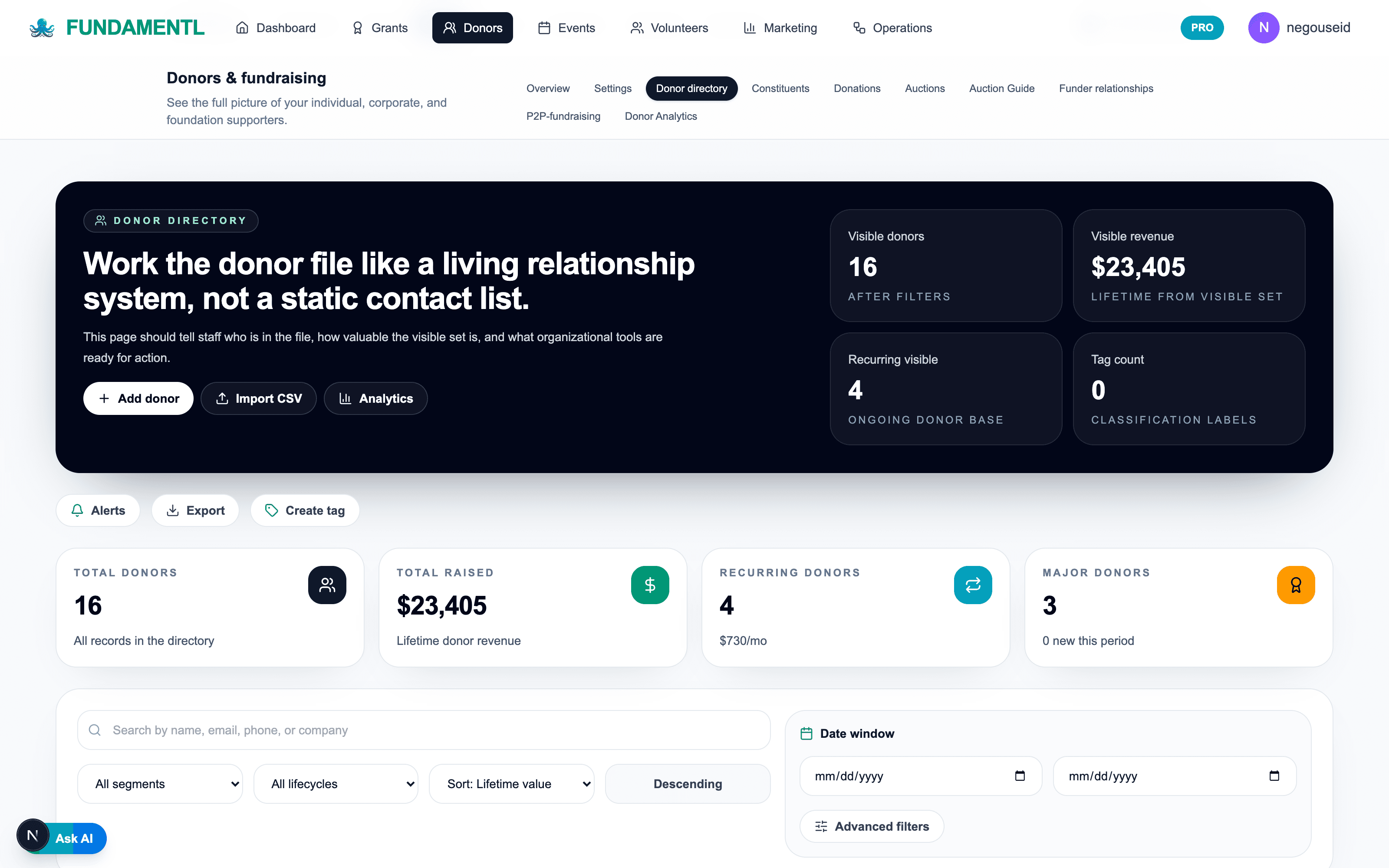
This is the biggest difference. Bloomerang is donor-centered. Fundamentl covers donor work while also owning the grant side of the house.
Cross-functional follow-through
Events, volunteers, sponsorships, and operations can support the same donor and funding strategy instead of living outside the CRM.
More consolidation upside
For teams carrying a CRM plus grant tool plus operational tracking, Fundamentl reduces software sprawl more aggressively.
Migration path
See the Bloomerang migration path before you switch.
The question is not just where records go. It is how a signal turns into an owner, a due date, a follow-up, and a report once the team is working in the new system.
See the Bloomerang migration pathFundraising plus grants
This is the biggest difference. Bloomerang is donor-centered. Fundamentl covers donor work while also owning the grant side of the house.
Cross-functional follow-through
Events, volunteers, sponsorships, and operations can support the same donor and funding strategy instead of living outside the CRM.
More consolidation upside
For teams carrying a CRM plus grant tool plus operational tracking, Fundamentl reduces software sprawl more aggressively.
Feature comparison
Side-by-side where it matters.
| Area | Bloomerang | Fundamentl |
|---|---|---|
| Donor CRM | ||
| Donor records and history | Strong | Strong |
| Retention and engagement workflows | Strong | Strong |
| Campaign and fundraising context | Strong donor focus | Strong donor focus with broader nonprofit context |
| Grant and institutional funding | ||
| Grant discovery | Separate system needed | Included |
| Grant application workflow | Separate system needed | Included |
| Grant writing and research support | Separate system needed | Included |
| Broader operations | ||
| Events and ticketing | Often separate tooling | Included |
| Volunteer workflows | Often separate tooling | Included |
| Board and operations reporting | More limited outside CRM scope | Included |
Questions buyers ask
Use the comparison, then choose the operating model you actually want.
Can Fundamentl really replace Bloomerang for donor teams?+
It can for organizations that want a donor CRM plus broader grants and operations functionality in the same system. The fit is strongest when Bloomerang is only one piece of a larger fragmented stack.
Who should stay with Bloomerang?+
If the team is deeply donor-centric and already satisfied with separate grant and operations tools, staying with Bloomerang can make sense.
What is the biggest advantage of switching?+
The biggest advantage is bringing donor relationships, grant workflow, and the follow-up work around them into one calmer operating system.
Next best steps
Keep the evaluation moving.
If the current stack is forcing your team to rebuild context every week, the problem is not just price. It is the operating model.