Comparison guide
Fundamentl vs Salesforce NPSP
Get nonprofit workflow depth without the admin burden, implementation drag, or connector sprawl.
Salesforce NPSP can be powerful, but it is often too heavy for lean nonprofit teams. Fundamentl is built for teams that need clarity and speed without giving up serious operational coverage.
- Designed for lean nonprofit teams, not full-time admins
- Faster time to usable workflows
- Grants, donors, events, and ops included by default
Salesforce NPSP
$1,200+ base
annual licensing before implementation, admin, and add-ons
Best if you need
- Large orgs with technical admins and customization budgets
- Teams prioritizing highly custom object architecture
- Enterprises already deeply committed to the Salesforce ecosystem
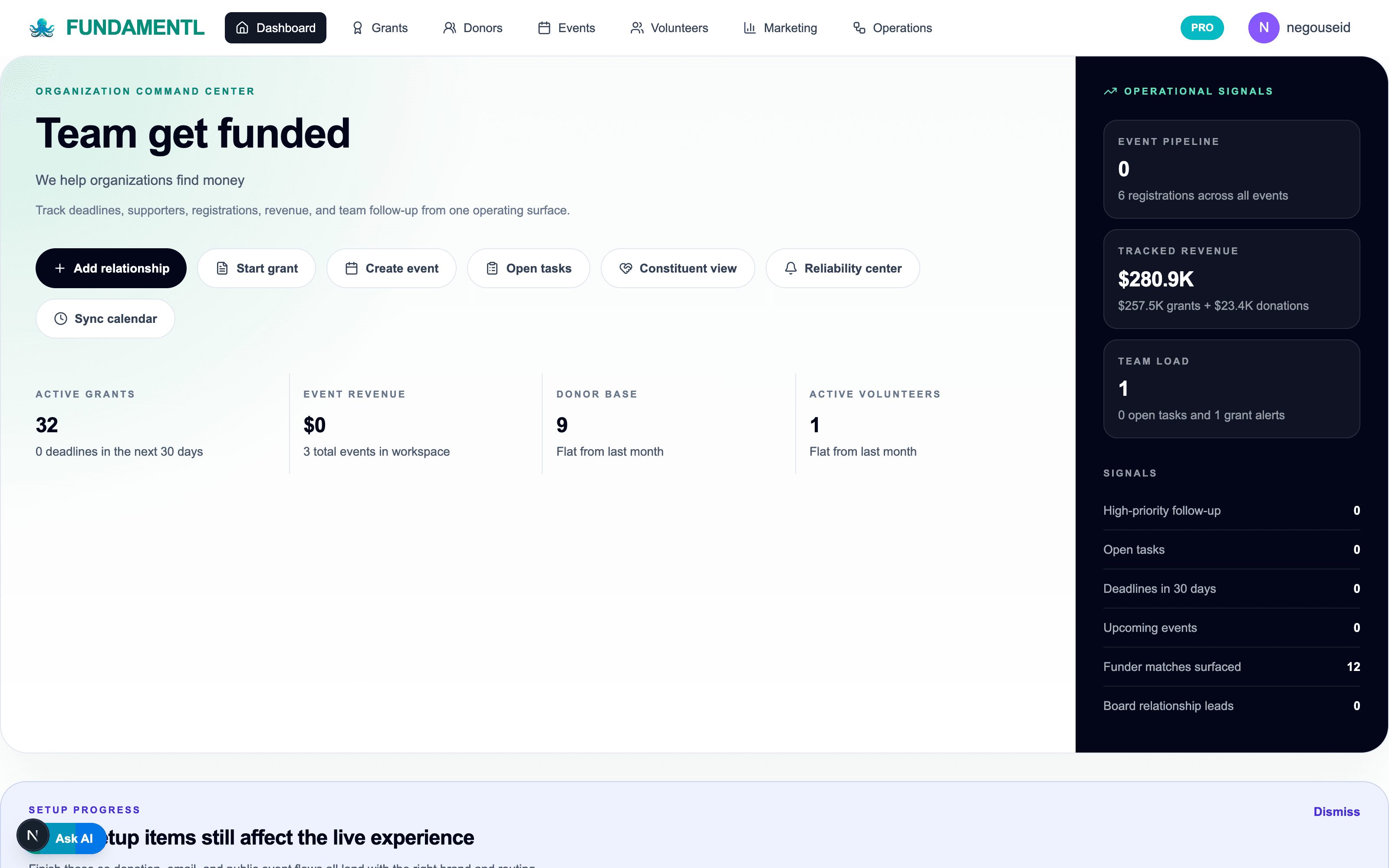
Fundamentl
$49-$249
monthly with faster adoption and broader nonprofit-native defaults
Best if you need
- Small and midsize nonprofits that need to move now
- Teams without dedicated CRM admins
- Organizations that want working defaults for fundraising and grant workflows
The actual difference
Fundamentl wins when your team needs a working system, not just a point solution.
Faster path to value
Fundamentl is built to be used, not implemented for months before it becomes usable.
Nonprofit-native defaults
The product already assumes grant tracking, donor CRM, events, volunteers, and board reporting as first-class workflows.
Lower administrative burden
Teams can focus on funding and operations instead of maintaining a heavily customized CRM environment.
Migration path
See the Salesforce NPSP migration path before you switch.
The question is not just where records go. It is how a signal turns into an owner, a due date, a follow-up, and a report once the team is working in the new system.
See the Salesforce NPSP migration pathFaster path to value
Fundamentl is built to be used, not implemented for months before it becomes usable.
Nonprofit-native defaults
The product already assumes grant tracking, donor CRM, events, volunteers, and board reporting as first-class workflows.
Lower administrative burden
Teams can focus on funding and operations instead of maintaining a heavily customized CRM environment.
Feature comparison
Side-by-side where it matters.
| Area | Salesforce NPSP | Fundamentl |
|---|---|---|
| Adoption and complexity | ||
| Time to usable workflow | Often long implementation cycle | Fast setup |
| Need for technical admin support | Often high | Low for typical nonprofit teams |
| Nonprofit-native out-of-box fit | Requires setup and customization | Built with nonprofit workflows in mind |
| Core nonprofit workflows | ||
| Donor CRM | Strong with setup investment | Strong with faster onboarding |
| Grant management | Usually custom or external | Included |
| Events and volunteer workflows | Often extra tooling or custom setup | Included |
| Operating model | ||
| Leadership reporting | Powerful but setup-dependent | Clear default visibility |
| Tool sprawl reduction | Possible but effort-heavy | Designed for it |
| Cost predictability | Often expands with services and add-ons | More straightforward |
Questions buyers ask
Use the comparison, then choose the operating model you actually want.
Is Fundamentl trying to be a general-purpose CRM like Salesforce?+
No. The product is intentionally narrower and more opinionated. It is built around the workflows nonprofit teams actually run every week, not around generic CRM customization depth.
When should a nonprofit still choose Salesforce NPSP?+
When the organization has the internal admin capacity, budget, and governance to support a heavily customized Salesforce environment.
What do teams usually gain by switching?+
They usually gain speed, clarity, and lower operational overhead. The software becomes easier to use and harder to neglect.
Next best steps
Keep the evaluation moving.
If the current stack is forcing your team to rebuild context every week, the problem is not just price. It is the operating model.