Donor CRM
Donor management for nonprofits that want cleaner stewardship and less CRM sprawl.
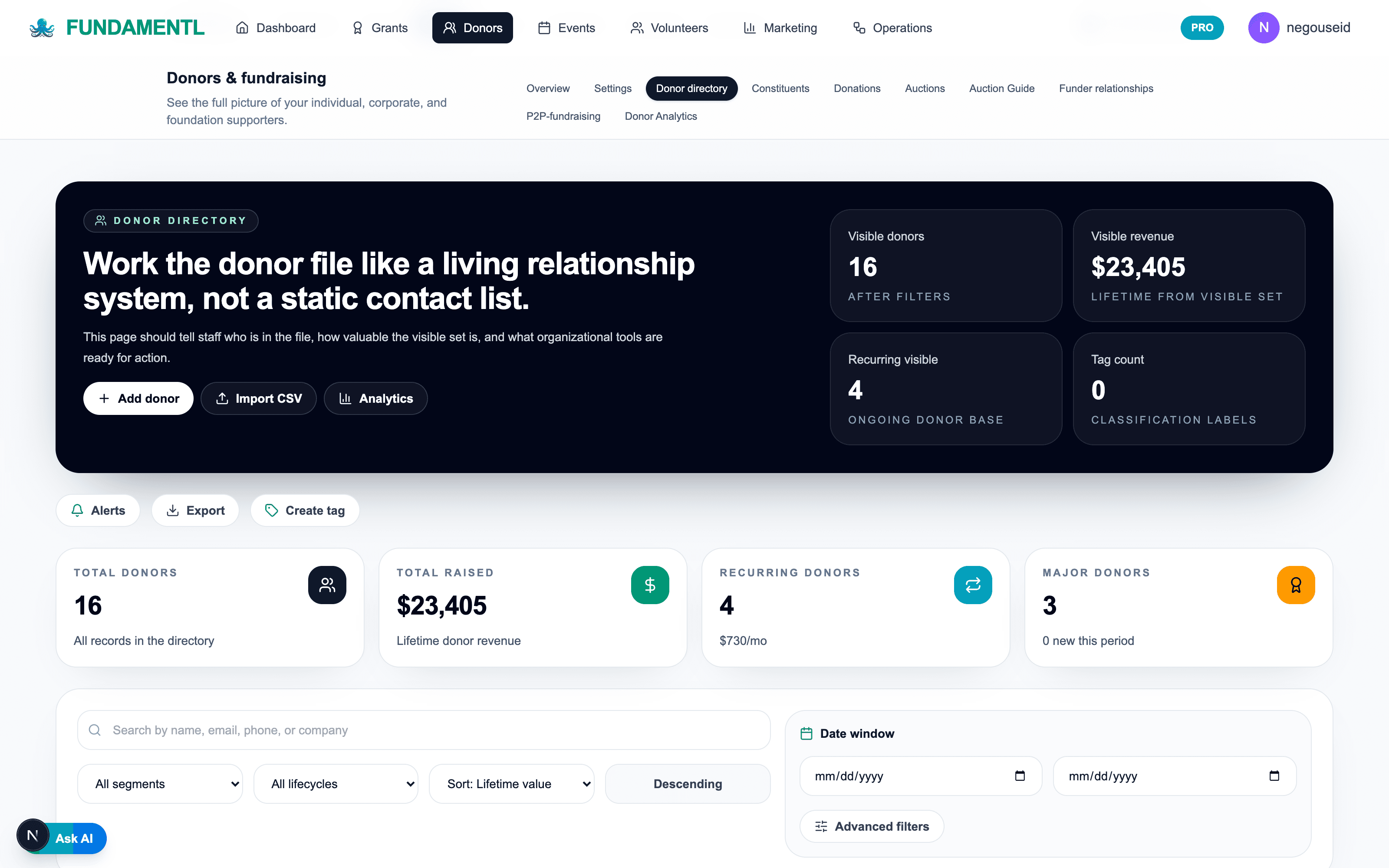
Fundamentl helps development teams see donor history, segment supporters, launch follow-up campaigns, and track giving momentum from one nonprofit system. It is built for teams that need a practical donor workflow, not a bloated general-purpose CRM.
- Online donation forms and donor profiles
- Segmentation, campaigns, and stewardship follow-up
- Built to connect with grants, events, and operations data
What improves first
- 1 timeline
- for donor history, touchpoints, and follow-up context
- Segment-ready
- for appeals, nurture, and donor-specific messaging
- Recurring-aware
- so retention and monthly giving trends stay visible
- $49+
- starting price without enterprise CRM overhead
Screenshots, feature descriptions, and visible product claims reflect the current product build as of May 13, 2026.
Product views
What does donor management CRM look like in practice?
These are real screens from the current module so buyers can evaluate workflow depth, not just abstract feature claims.
Relationship portfolio
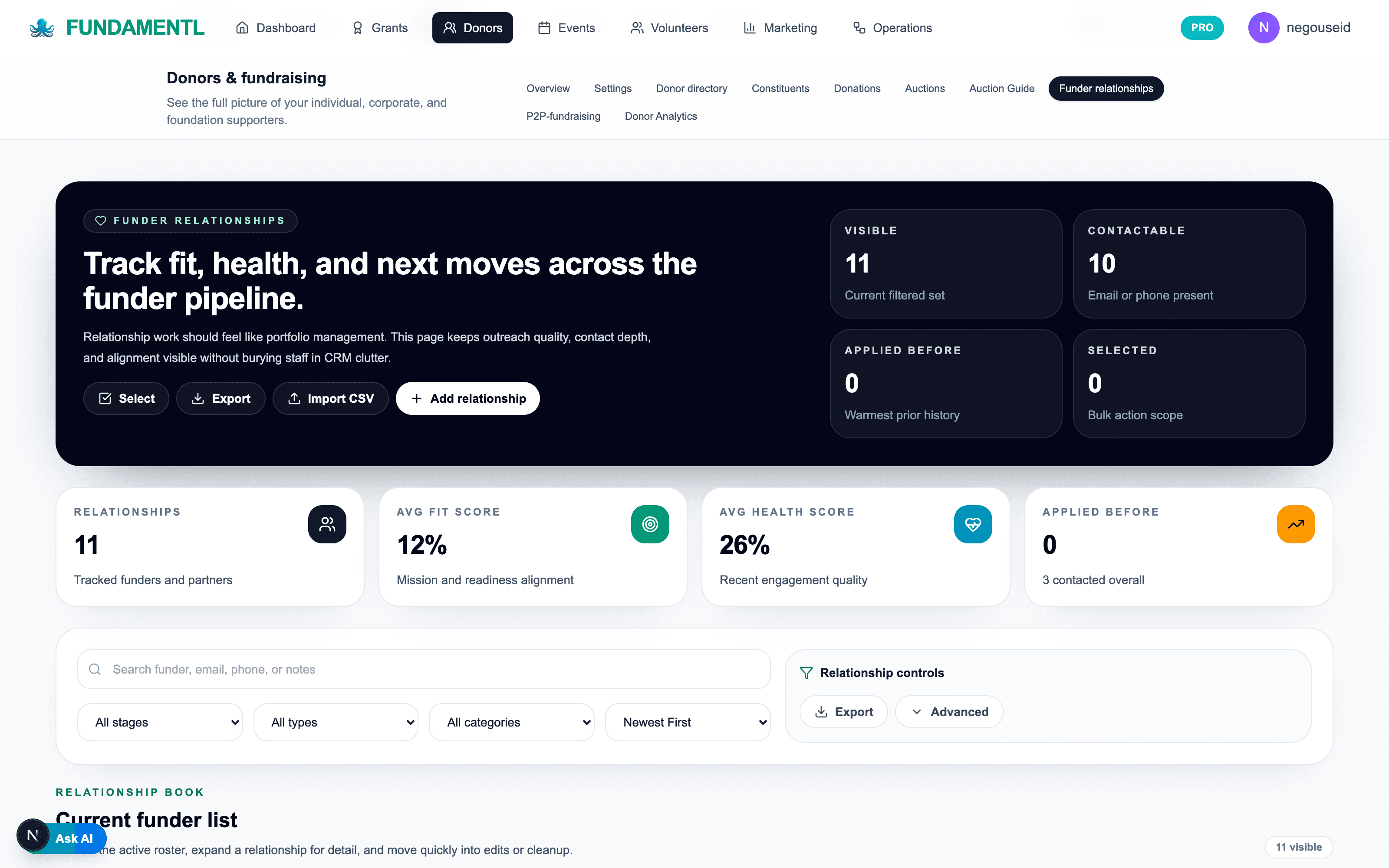
Track fit, health, and next moves across donor and funder relationships.
Audience targeting
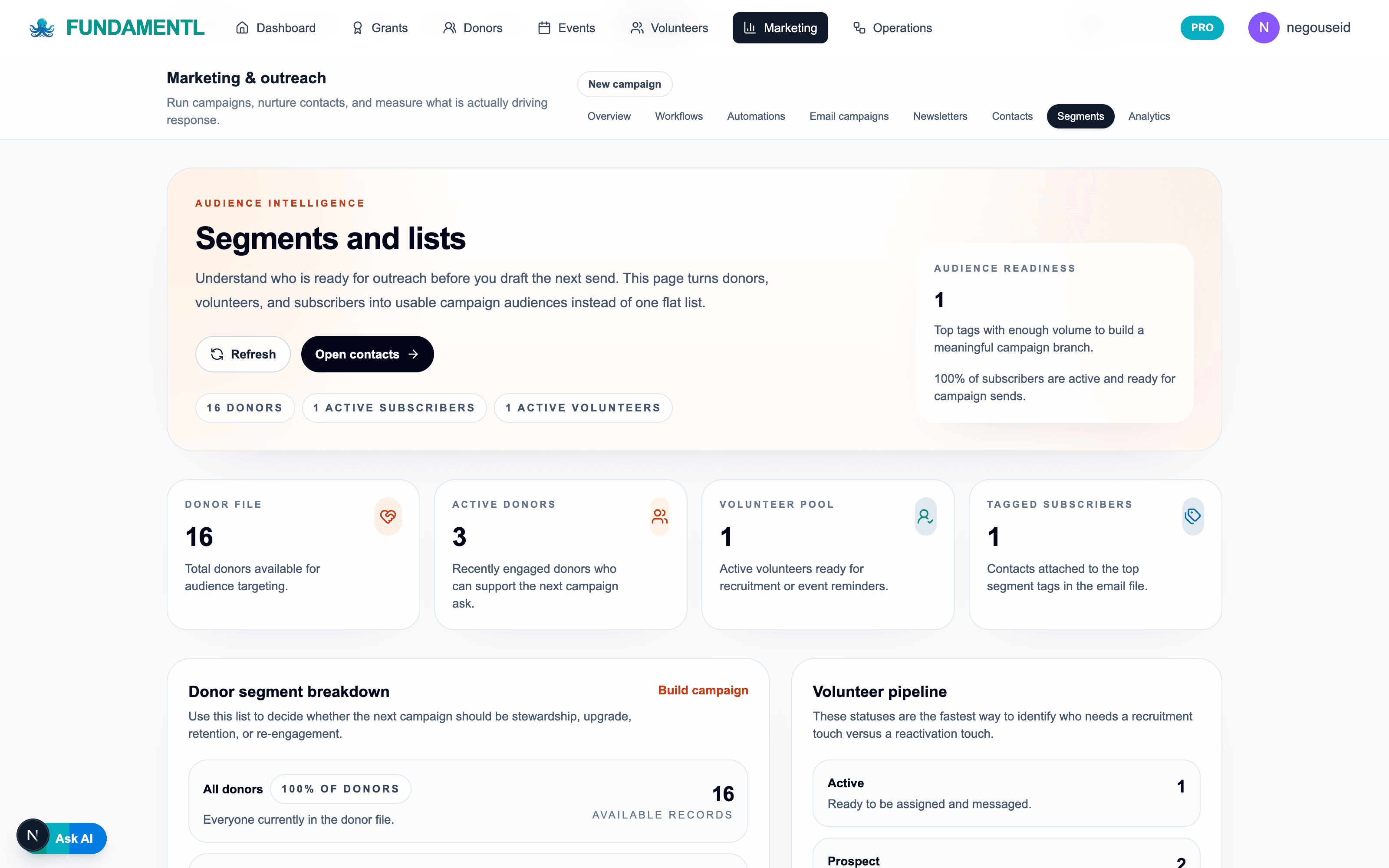
Turn donor data into usable segments instead of exporting static lists.
Best fit
Who is donor management CRM best for?
A nonprofit CRM should do more than hold contact records. It should help the team decide who to follow up with, what changed in the relationship, how campaigns performed, and where revenue momentum is softening before it becomes a bigger problem.
Best for
- Development teams that need cleaner donor history and easier segmentation
- Organizations combining appeals, events, and ongoing stewardship in one system
- Nonprofits outgrowing lightweight lists but avoiding enterprise CRM complexity
Why teams switch
- Giving history, campaigns, and follow-up stay connected in the same record
- Segments become easier to act on because the underlying donor context is cleaner
- Retention and recurring revenue trends are easier to read without a reporting rebuild
From donor chaos to donor continuity
The hardest donor problem is usually fragmented relationship context, not a lack of contacts.
When giving history, campaign behavior, and stewardship notes live apart, the team ends up sending weaker outreach and missing the right follow-up timing.

Common donor CRM headaches
The common workflow drag this product is built to reduce.
Common donor CRM headaches
Fragmented donor history
Gift records, notes, event participation, and campaign context sit in different systems or spreadsheets.
Generic outreach
Appeals and stewardship go out without enough context about recency, engagement, or donor behavior.
Manual retention tracking
The team spots lapsed donors too late because the real relationship signals are hard to read.

Fundamentl
One donor record and outreach layer
What the connected system fixes
The calmer connected workflow teams can move toward.
What the connected system fixes
Unified donor timeline
Giving, engagement, and key relationship moments stay visible in the same donor record.
Segments tied to real supporter behavior
Audience targeting becomes more useful because it reflects what the donor actually did.
Stewardship and retention visibility
Campaign response and follow-up stay connected, so the next donor action is easier to prioritize.
What changes
What improves after switching to donor management CRM?
More useful donor context
The team can see gift history, engagement, and what happened last without hunting through separate tools and old campaign exports.
Better stewardship timing
Donor follow-up gets shaped by actual giving and engagement behavior instead of generic mass outreach.
A calmer fundraising record
Online forms, donor activity, campaigns, and related workflows stay in one operating layer instead of being split between a payment system, CRM, and email tool.
Workflow sequence
How does donor management CRM fit the day-to-day workflow?
Step 1
Capture the gift cleanly
Start with donation forms and donor records that keep payment, contact, and giving context together.
Step 2
Segment supporters with real context
Build segments from giving history, recency, and engagement signals that are actually useful for stewardship and appeals.
Step 3
Launch follow-up without losing the thread
Send campaigns and stewardship touches from the same system that holds the donor relationship record.
Step 4
Watch retention and revenue health
Use giving analytics and donor trends to see what is growing, what is softening, and where the next action should happen.
Included in the module
What features are included in donor management CRM?
Donation capture and receipts
Online forms for one-time and recurring gifts with cleaner downstream donor records.
Donor profiles and timelines
A single donor record for giving history, engagement notes, and relationship visibility.
Audience segmentation
Build more useful lists for appeals, follow-up, and donor stewardship without spreadsheet exports.
Campaign execution
Send outreach and track results from the same system that stores donor behavior and context.
Giving analytics
See retention, recurring revenue, and campaign performance without a separate BI layer.
Connected nonprofit workflows
Tie donor work into events, grants, and the rest of the operating system when the organization needs a broader picture.
What teams are replacing
- Payment forms disconnected from the real donor record
- A CRM that is hard to maintain or too generic to drive action
- Manual segment exports and stewardship spreadsheets
- Campaign tools that cannot see the full donor relationship
What Fundamentl changes
- One donor system for gifts, outreach, and follow-up context
- Clearer segmentation tied to live donor behavior
- Less rework between donation capture, campaigns, and stewardship
- A more practical CRM for lean nonprofit teams
Next moves
Keep the evaluation moving with a guide, a tool, or a comparison page.
Open the donors guide
See how Fundamentl positions donor workflows, retention, and constituent management.
Open the donor retention toolkit
Estimate retention leakage, reactivate lapsed donors, segment supporters, and improve appeals before importing the workflow.
Compare Fundamentl vs Bloomerang
See how Fundamentl differs from a donor-first CRM when the org needs broader workflow coverage.
Questions buyers ask
Frequently asked questions about donor management CRM
Is this a full donor CRM or just donation forms plus email?+
It is meant to be a donor operating workflow, not just a form layer. Donation capture, donor history, segmentation, and campaign activity stay connected in the same system.
Can this work if we also run events and grant fundraising?+
Yes. That is one of the reasons Fundamentl exists. It is designed to reduce tool sprawl when donor work overlaps with grants, events, and broader nonprofit operations.
Who should still choose a heavier CRM?+
A team with strong internal admin capacity and a need for deep enterprise customization may still want a heavier platform. Fundamentl is aimed at lean teams that want clarity, speed, and broader workflow coverage.
Final step
Treat donor stewardship like a working system, not a list plus a send tool.
If donor follow-up still depends on exports, memory, and campaign-by-campaign cleanup, the CRM is not carrying enough weight. Use a system that keeps giving, segmentation, and follow-through attached to the same relationship record.
Start free, then grow into the fuller operating system as the team needs it.